
Initiatory tale of the Método Peixe de Aquacidade · ~10 minute read
The Legend of the Golden Dolphin
The orphan who thought he was an alligator. The four waves that return to each of us our own sea. A legend written by Henrique Pistilli, the Fishman — retold and expanded by the animals of the island.
There was an uncounted time, before clocks, when fresh water still courted the sea at the edge of a warm lagoon. It was there, stranded among roots and mud, that a dolphin calf was found — small, trembling, too far from the surf to remember where it had come from.
It was a group of alligators who found him. And — wonder of wonders — they did not devour him. They took him in. They raised him as a son, as an equal, teaching him everything an alligator needs to know: to lie still under the sun, to distrust every shadow, to snap the jaw shut before thinking. The little one grew up this way, believing himself a reptile. He swam strong, armored, always on high guard. No one had told him — because no one knew — that inside, he was made of a different water. That he carried a warm breath where cold blood should be. That his body had been shaped not for the ambush, but for the leap.
This is how every human biography begins: we’re born into the school that finds us, and for a long time we mistake the house for the essence. We learn to survive on the ground we were given, and we call it identity. The path — the Método Peixe de Aquacidade, the Fish Method of Aquacidade — is the crossing of the four waves that return to each of us our own sea. Four movements. Four elements. Four bodies. And, in each one, teachers who appear exactly when the student is ready.
Movement I · Earth — Security
The Alligator was the first teacher, and the roughest. He taught the dolphin the armor: to enter and leave the water at the exact moment he chose, above and below the surface, without hesitating. He taught him to take the wipeout — to tumble along the bottom, scrape the coral, swallow water, and still come back up. “The first law of the sea,” the old one growled, “isn’t swimming pretty. It’s not dying.” The dolphin learned to survive the impact. He learned that fear, well used, is a bodyguard.
The Skink — the gleaming lizard of the sunlit rocks — taught the opposite of movement: watchful stillness. She would stay motionless on the rock for hours, warming herself, alert to everything, spending nothing. “You don’t need to react to every wave,” she said, without turning her head. “Anchor in solid ground. Wait unmoving. Trust the rock that holds you up. There’s a strength that only shows up in those who know how to stay still.” The dolphin, restless by nature, took a long time to understand — but he kept it: there’s a security that doesn’t come from effort, it comes from the root.
And then came the Shark — the great teacher of fear. Not the fear that paralyzes, that locks the breath and drowns; nor the recklessness of the fool who thinks himself immortal. The Shark taught fear in the right measure — the kind that sharpens the senses, quickens the blood at the right moment, and builds the courage to surf the wave of uncertainty. “Without me,” he said, circling slowly, “you’re prey, or you’re dead. With me, in the right dose, you become the hunter of your own life.”
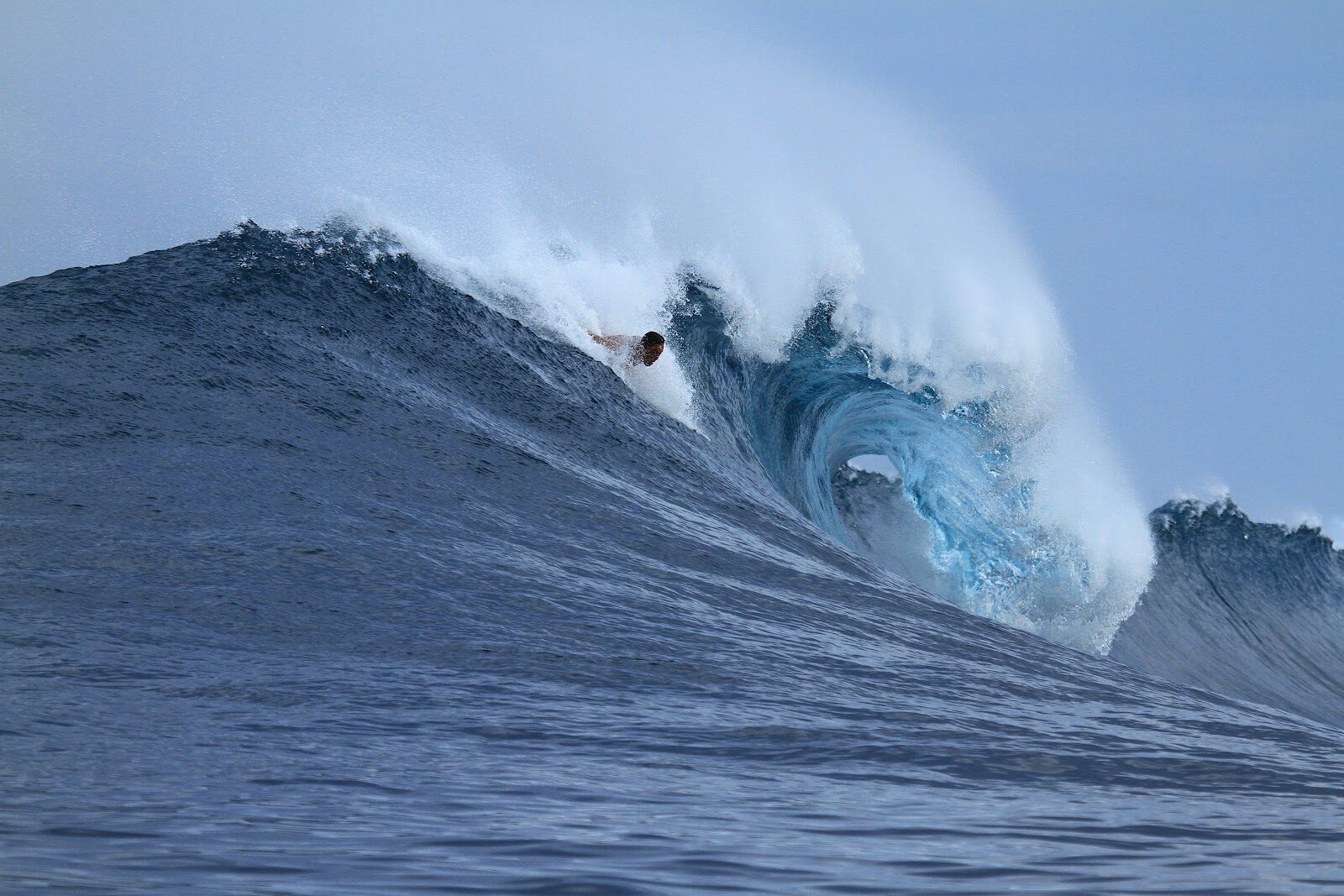
But the Earth demands its proof. Full of himself, drunk on his newly learned armor, the dolphin challenged the shallow reef on a day of three-meter waves. He wanted to prove he was the toughest thing on the reef. He paddled too early, picked the wrong wave, and got caught on the lip — falling down the face of the wave, scraping his whole belly on the sharp coral. He bled. He was left dizzy, alone, the water burning in his open wounds. That’s when the lobsters came. They came out of their dens in the dark and, with antennae and secretions, cleaned every cut, until the burning turned to tingling and the tingling turned to healing. He learned in his own flesh the deepest lesson of the first movement: the first home is the body. And security isn’t the absence of fear — it’s making peace with it.
Movement II · Water — Fluidity
Healed but restless, the dolphin kept swimming like an alligator — stiff, tense, spending twice the strength for half the distance. Until, on an afternoon of calm green water, a Water Serpent crossed his path. She didn’t attack. She came alongside, undulating, and laughed — a sweet laugh, no teeth showing. “How strange,” she said. “For a moment I thought you were an alligator. You swim with so much strength… and so little grace. You can be anything, creature — anything but an alligator.”
The Serpent promised him a secret: gliding along the walls of the wave by twisting his whole body, letting the water itself do the pushing — all the speed, none of the exhaustion. “Don’t beat the wave,” she whispered. “Become the wave.” For the first time, the dolphin felt his body working with the sea, not against it.
From her den in a crack in the rock, the Moray taught timing. Old, patient, she only came out at the exact instant the tide turned. “Haste is waste,” she said, without leaving her hole. “The sea has its hour. Whoever leaves too soon, fights. Whoever leaves on time, flies. Learn to wait — waiting is also movement.” And the Turtle, the oldest of all, taught the rhythm of one who swims to a hundred years: “Let the current do the work for you. Maximum result, minimum effort. The old ones call this Aquacidade — the art of moving through water with maximum result and minimum effort.” The dolphin spent whole moons beside her, unlearning haste.
Months later, he already flowed like a serpent along the liquid walls, left at the moray’s hour, conserved his strength like the turtle. And he felt, with a start, something that would change everything: he no longer belonged to the alligators’ group. The armor had fallen away without pain. This is fluidity — discovering the gift that makes time stop, and letting go, without guilt, of what we never were, to swim light in what we always were.
Movement III · Air — Creativity
It was a chatty Seagull, perched on a headland, who opened the sky for the dolphin. She had flown over every coastline in the world, spoke the languages of every wind, and told stories no one believed — among them, one about a distant, perfect island, where true dolphins danced by moonlight. “You swim beautifully,” said the Seagull, “but you only know what’s below. There’s a whole world above the surface. Leap! Spin! Come out of the water and tell me what you see.” It was with her that the dolphin learned to break the surface, to spin in the air, to taste flight.
“The dolphin doesn’t swim against the current — he reads the tide and glides with it. That’s the legend the school carries.”Legend of the Golden Dolphin
The Noronha Booby carried the lesson further: he showed the dive-strike. He’d climb high, take aim, and plunge like a spear. “Creativity is courage,” he shouted into the wind. “It’s spotting the fish from up high and having the nerve to dive headfirst after it. Whoever just floats never catches the dream.” The Frigatebird, with her immense wings, taught how to glide for hours without a single wingbeat: “Dreaming isn’t effort. It’s gaining height and seeing far.” And the Tropicbird — rare, white, with a tail as long as a paintbrush — taught the unique signature: “Don’t copy anyone else’s wing. The art that matters is born from your own creative idleness, your own way, and no one else’s.”
But the Air has its trial, and it’s the most treacherous one. At the height of his euphoria, feeling beautiful and powerful, the dolphin was seduced. The Great White Shark — no longer the teacher of rightful fear, but now the shadow, the predator drunk on power — reappeared, sleek and enormous, and whispered the perfect bait: “Why just fly, when you could reign? Be the owner of the ocean. The most feared. The most admired. Everyone will bow.”
The dolphin took the bait of vanity. He traded the dream for power, meaning for admiration. And he swam in search of more and more dominion, until he lost himself in icy seas where no creature sang. There, his heart nearly froze. He became a living dead thing, hibernating in the dark, forgetting he had ever known how to fly. Creativity without purpose becomes inflation; talent in the service of ego becomes ice. It took touching the very bottom of his own coldness for an old memory — the wings, the island, the dance — to catch fire again. And the dolphin chose: to fly not toward power, but toward meaning.
Movement IV · Fire — Authenticity
To get out of the ice, a heroic crossing was needed. Under a storm that tore open the sky — lightning, thunder, waves like mountains — the dolphin crossed the open ocean. He didn’t fight the storm: he revered it. For the first time, he felt small before something immensely greater, and in that smallness he found, paradoxically, his greatest strength. It was as if the ocean itself were pointing the way. And when the storm passed, he was in warm, blue waters — and he wasn’t alone. There were other dolphins. His own kind. For the first time, he recognized himself.
The Dolphin — now an equal — taught leadership that breathes together: the school that moves as a single body, play as a form of learning, service as a form of leading. The Whale taught the deep song and ancestral memory: “Carry the memory of those who came before. Sing for those who’ll come after. Depth is never in a hurry.” The Orca taught power that doesn’t show off: “Power isn’t dominating. It’s protecting.” And the Beluga, white and gentle, taught transparency: “Whoever has reached the bottom of themselves no longer needs a mask. Speak simply. Speak true. The greatest wisdom is the kind a child understands.”
But the last test remained — and it was the most subtle. Arriving near the perfect island, the dolphin found the Mermaid. Not the villain of old tales: something deeper. The Mermaid was the song of normosis, of disrhythm — the spell that hypnotizes, that lulls to sleep, that makes whole beings live mechanically, with a vacant stare, forgetting they’re alive. She sang, and all around her an entire people lived asleep, prisoners of cages they didn’t even realize they had.
The dolphin didn’t defeat the Mermaid by force. No force could defeat a sleeping spell. He won by teaching. He approached one, then another, and reminded each one — through story, through play, through example — who they were beneath the enchantment. He woke them one by one, radiating. He showed each sleeping creature that it, too, could find its own path and be prince of itself. And as he woke the others, his own light grew.
He was then recognized as the Golden Dolphin — the one who absorbed the forces of earth, water, air, and fire and came back to serve. He didn’t keep the gold he’d won: he shared it. He became a sage, a counselor, a teacher. The orphan who thought he was an alligator became the light that wakes schools of fish.
Epilogue · the gold given back
The Golden Dolphin doesn’t shine to be seen. He shines so the plants of the deep can grow, so the sleepers can wake, so the school can find its way in the dark. Every creature he teaches becomes, in turn, a light. And the gold, instead of being spent, multiplies.
Whoever swims the four waves — earth, water, air, and fire; Security, Fluidity, Creativity, Authenticity — finds, in the depths of their own chest, the gold that was always theirs. It didn’t come from outside. It was there from the beginning, beneath the alligator’s armor, waiting for the four crossings to reveal itself.
These are the 4 Phases of the Método Peixe de Aquacidade. Dive into each one, by your phase of life: Children · Teens · Adults · Leaders · Wise Soul.
#prafrentecomcoragem
“In the circle of the school, the Golden Dolphin is born.”IMUA · Escola do Mar · Noronha
Simbora?
Swim your four waves
The method the legend holds is lived in the water, in Noronha. Resident: free at the Institute. Visitor: immersions of 2 or 4 days.